

Image © Adobe Stock
GBP/AUD is engaged in a recovery sequence as the Middle East crisis works against the Aussie dollar.
Something we will be watching in the coming week is the evolving 'fuel crisis' in Australia. We don't call it a crisis, but observe that local media have decided that it is, in fact, a crisis.
And that matters: when businesses and consumers are told they are in a crisis, they start altering behaviour.
Unfortunately for the Australian economy, panic buying has meant there are real shortages, which might have been avoided had no one panicked.
The latest in the crisis involves the federal government laying out a Covid-style response plan, that will ultimately see fuel rationed.
Whichever way you cut it, that's bad for the domestic economy and severely tarnishes Australia's status as a global outperformer.
Consumer and business caution will take some heat out of the economy and lessen the need for the Reserve Bank of Australia (RBA) to push rates higher.
So for the Aussie dollar, there are two sources of recent support that have been dented: 1) economic outperformance and 2) elevated interest rates, which global investors tend to chase.
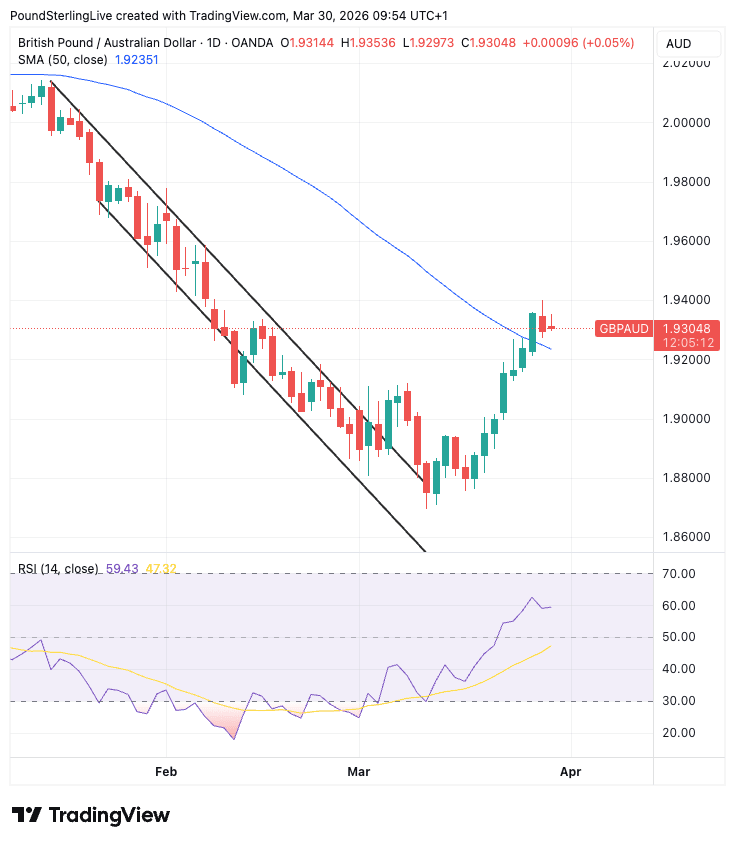
It's little wonder then that GBP/AUD has trended higher of late, testing 1.94 on Friday, having been as low as 1.8694 on March 11. Money transfer rates with all-in 0% fee providers rose as high as 1.9360 when spot was at its peak last week.
An uninterrupted run of seven daily advances meant that the recent rebound was a convincing one, but Friday's retreat from the highs and Monday's flatness suggest some steam is being lost.
Monday sees the pair unchanged around 1.9311 and the Relative Strength Indicator is turning lower again, so perhaps it's time to catch breath after the sharp rebound.
If so, then the coming week could see a decent spell of consolidation before the uptrend evolves further.
With signs that momentum is fading, timing becomes more important as the market moves into a consolidation phase. In this type of environment, some may look to set a target exchange rate or use market orders to capture short-term pullbacks, rather than chasing strength at current levels.
When Fuel Will be Rationed
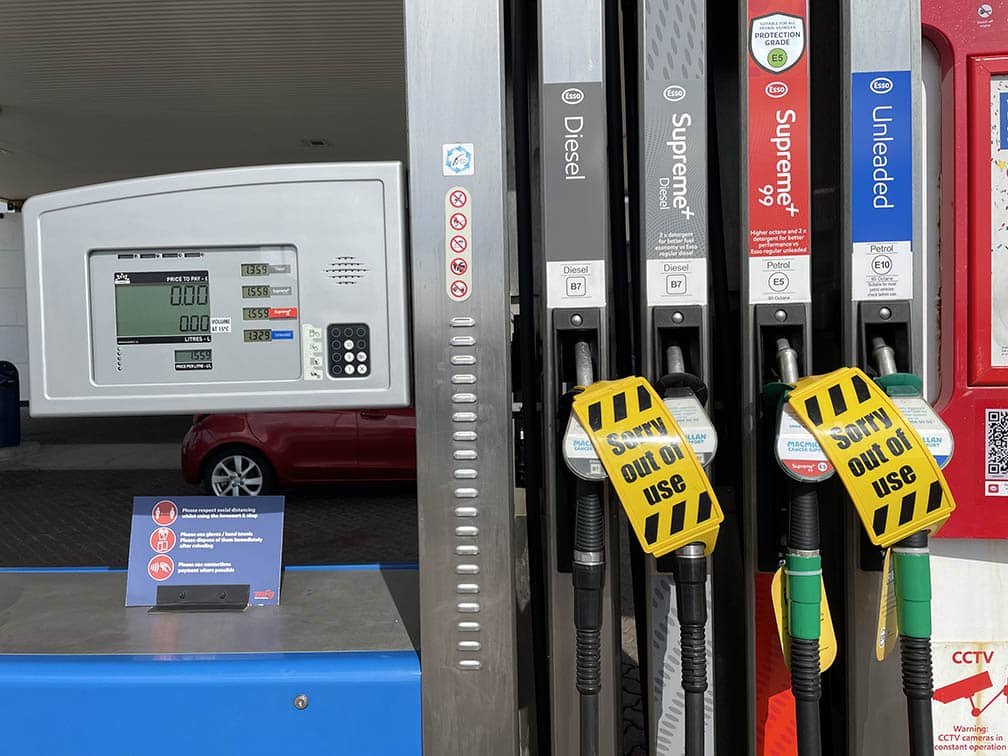
Image © Adobe Images
Monday saw the federal government announce a four-point National Security Fuel Plan in response to recent shortages and the ongoing war in the Middle East, which could escalate in the event of a U.S. ground invasion of parts of Iran.
Prime Minister Anthony Albanese unveiled the plan after he met with state leaders at an emergency National Cabinet on Monday.
The four stages are: 'plan and prepare,' 'keeping Australia moving,' 'taking targeted action' and 'protecting critical services for all Australians'.
The country is at stage two, and stage four is understood to involve fuel rationing.
Events in the Middle East have therefore offered GBP/AUD a route higher, breaking what was near-free-fall in the rate in the first two months of the year.
However, analysts warn that when the crisis shows signs of ending, the Aussie could reassert itself over sterling.
The British currency has also been aided by a material pick-up in expectations for rate hikes at the Bank of England. Rate expectations have risen more in the UK than in Australia over the course of March.
When the war ends, that would likely reverse, given the weak state of the UK economy, where lower central bank rates would be welcome.
Analysts at Rabobank say the market’s current projections of between two and three Bank of England rate hikes on a 1-year view are excessive, given the relatively soft position of UK growth at the start of this crisis.
"In the past couple of weeks GBP/AUD has turned higher. We would favour selling GBP/AUD into rallies targeting a move back below GBP/AUD1.90 in the weeks ahead," says Jane Foley, Senior FX Strategist at Rabobank.
GBP/AUD transfer strategy: thoughts for the week ahead
? Where larger transfers are involved, these swings can have a meaningful financial impact, particularly when combined with the wider margins typically charged by banks on international payments.
? Staging a transfer can also help balance risk. Splitting a transaction into smaller parts allows exposure to both current levels and any future improvement, reducing the need to rely on a single entry point.
For those unsure how to approach this balance between short-term opportunity and medium-term risk, access to guidance can help structure a more effective strategy.