
Image © Adobe Stock
Australian dollar weakness is building as the market pivots towards expecting Fed rate hikes.
GBP/AUD rises to 1.9087 in midweek trade amidst the Aussie's retreat, taking the pair above the important 100-day moving average and signalling that the downtrend of 2026 is at risk of failure.
The rally from the May low near 1.8550 has gathered momentum recently, carrying the pair above the 21-day moving average and straight into the falling 100-day moving average around 1.9040-1.9060.
The 100-day average has capped recovery attempts since August last year and therefore remains the defining marker separating the broader bearish trend from a more neutral outlook.
A daily close above 1.9050 would strengthen the case for further gains toward 1.92-1.93. However, failure at current levels could trigger profit-taking back toward 1.89.
The overall bias: constructive, with sterling attempting a potentially significant bullish breakout after months of underperformance.
However, participants should still respect the significance of the resistance zone as the broader trend remains lower, and it would not be unusual to see sellers attempt to defend the 100-day moving average aggressively after such a strong rally.
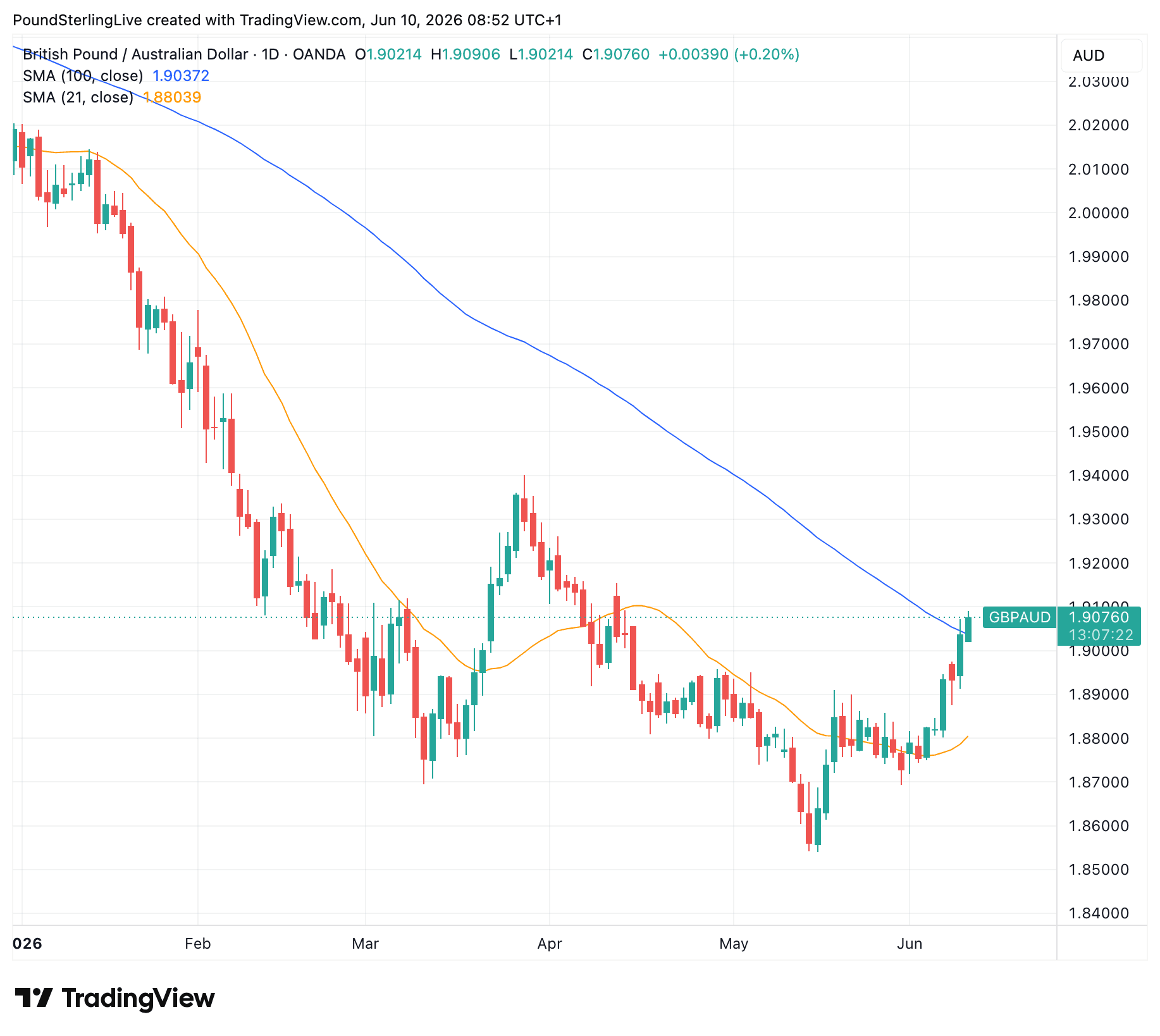
Above: The pound to Australian dollar at daily intervals.
Weighing on the Australian dollar of late has been a shift in global wind direction: the market has moved to prepare for an interest rate at the Federal Reserve at some point in the coming year, which douses the previously constructive sentiment backdrop that tends to assist the Aussie dollar.
"In G10, AUD and NOK have the most room to fall on hawkish Fed," says Jayati Bharadwaj, Head of FX Strategy at TD Securities.
"In our baseline scenario where Warsh does not push back against the FOMC's expected hawkish shift, the broad USD uptrend should have more room to run in the short-term. AUD and NOK should lead G10 FX loss against the USD in this scenario as they are risk-sensitive," she explains.
The need for the Fed to raise rates follows a run of consensus-beating data, which should be reinforced by Wednesday's CPI inflation release.
Inflation is expected to beat expectations with a 0.5% m/m reading, which should prompt a guidance shift at next week's Fed policy decision from 'dovish' to neutral. To be sure, new Chair Kevin Warsh will be reluctant to talk about rate hikes outright, but he won't be able to avoid the need to warn that hikes could now be a prospect to consider.
As the dial shifts on U.S. rates, headwinds blow for the global stock bull run, and the high-beta Aussie dollar is a prime candidate to bet against under such a scenario, particularly given its very strong run in H1.