

File image of Ed Miliband. Picture by Dan Dennison / DESNZ, copyright: Gov.uk.
The market is underpriced for the prospect of Ed Miliband becoming the next Chancellor.
The British pound has risen against the euro and other G10 peers in the wake of Keir Starmer's resignation speech, but it could face a significant setback if a left-leaning figure is put in control of the country's finances.
The Times reports Thursday that Ed Miliband "is said to be in the running for chancellor in the new cabinet" to be announced once Andy Burnham becomes Prime Minister.
That's not a controversial development, and the pound already knows he's in the running, but the report also indicates Miliband has been far more engaged in Burnham's economic policy framework than previously thought.
"Ed Miliband is playing an integral role in developing economic policies for Andy Burnham’s government," says Steven Swinford, Political Editor at The Times. Miliband is "developing key policies for Burnham, particularly those with fiscal implications, and feeding them to his transition team."
Betting markets, which give a strong indication of underlying market sentiment and positioning, have just woken up to the idea.
In mid-morning London, we've seen the odds of a Miliband chancellorship jump on Polymarket from 19% to 28%.
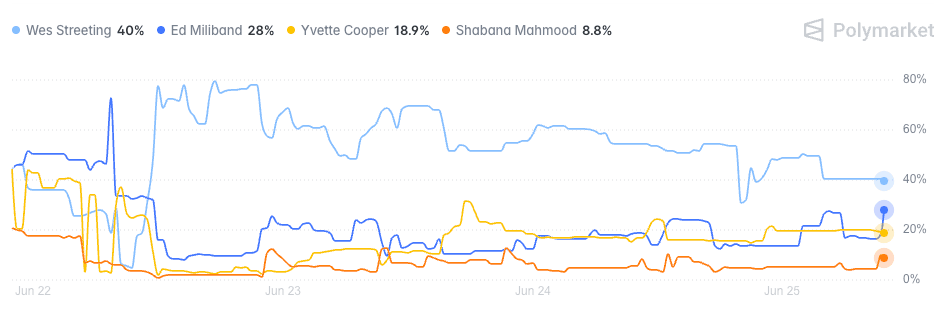
The scale of Miliband's engagement in the economic and fiscal policy design, as reported by the Times, might therefore still be underpriced by currency markets.
The pound has risen against the euro and dollar over recent days partly on "the possibility that Burnham selects a less left-wing Chancellor, who offsets some market concerns," says Dominic Bunning, strategist at Nomura.
Bunning's colleague, economist George Buckley, explains that Burnham's fiscal route will be signalled by his pick for Chancellor.
"Does he choose someone from the party’s right-wing... or someone who is more widely considered to be spendthrift from the party’s left," asks Buckley.
Streeting, the current favourite for the job (45% with Polymarket), is considered a figure who might oversee a Treasury that sticks as closely as possible to the existing fiscal framework that requires high levels of discipline on borrowing.
"Burnham’s plans are likely to be towards a more interventionist state," says Buckley. "Whether this can be achieved under the current set of fiscal rules is perhaps the most important question that needs answering by the incoming administration."
For the pound, a Miliband chancellorship is therefore a significant headwind in H2 that's currently underpriced.
The Risks for the Pound Skew to November
The fiscal decisions of the incoming government will determine how the pound trades into year-end, and we're already hearing from a number of prominent analysts at JP Morgan and Goldman Sachs that the Autumn budget could prove to be the next major flashpoint for GBP risks.
Nomura's Bunning says changes to the fiscal rules under a Burnham government presents "the most obvious" tail risks for GBP.
"Even those deemed as tweaks rather than wholesale changes," such decisions would "risk a negative gilt reaction and see GBP trade under an 'EM FX framework," says Bunning.
The EM FX framework is where the pound falls alongside bonds. Typically, falling bonds result in higher bond yields, which attract inflows of capital, thereby boosting the pound.
When that relationship breaks down, we have a sure sign of underlying market panic.
"With foreign ownership of UK bonds elevated and fiscal headroom seemingly tight, this risk remains more pronounced than appears to be priced," says Bunning.
Miliband and Burnham Are Aligned
To get an idea of what Miliband brings, cast your mind back to February, when he urged PM Starmer to take the government in a leftward direction in order to resuscitate his fading fortunes following the departure of Morgan McSweeney as Cabinet Secretary.
We reported back then that Burnham joined Miliband in pressuring the government to lean leftward: "senior Labour figures including Ed Miliband and Andy Burnham are urging the Prime Minister to learn from the episode and turn his government leftward."
In a speech delivered in London around that time, Burnham urged Starmer to pursue new policies, including funding the construction of half a million new council homes and subsidising bills for the poorest people in society.
The Burnham-Miliband axis is therefore a strong one, and all the evidence says it spins leftward.