

Image © Adobe Images
Pound sterling is forecast to lose ground against the euro over the coming year as some of sterling’s most important supports begin to fade, according to new research from Citi.
The investment bank, one of the world's biggest prime dealers of currency, says foreign demand for UK government bonds has played a crucial role in keeping the euro "at bay", but doubts that support can continue indefinitely.
"We attribute this to foreign inflows into gilts amid attractive UK yields," says Citi, referring to sterling’s resilience against the euro in recent months:
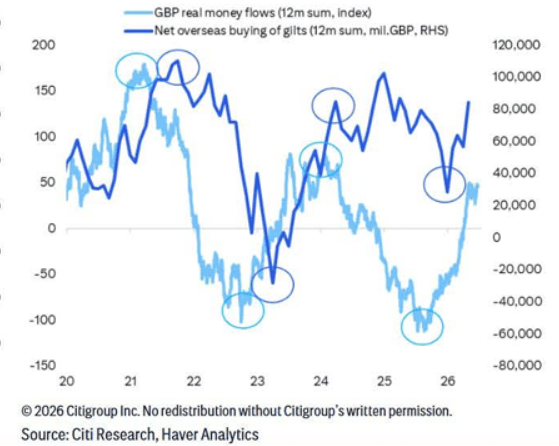
Gilts in charge: Citi says GBP has kept EUR at bay because of strong foreign buyer demand for UK gilts (proxied via real money flows).
What's Supporting the Pound?
A rise in UK bond (gilt) yields, particularly since the Iran conflict raised inflation expectations, has supported the pound over recent weeks and helped it outperform the euro.
This demand helped the pound-to-euro exchange rate rise to a multi-month high at 1.1624 on June 24 and has quietly established a new short-term base just above 1.16 in the ensuing weeks, suggesting a slow but steady grinding down of 1.16 resistance is underway.
However, gilt demand has offset fundamentals that, in Citi's view, should already have pushed GBP/EUR lower.
Looking ahead, Citi expects those fundamentals to reassert themselves.
"Our EURGBP forecast reflects fundamentals more than a continuation in such flows," the bank says in a mid-year currency market review, adding that it pencils in "modest upside" for EUR/GBP over the next three months.
That translates into a modest decline in GBP/EUR from current levels.
The near-term shift reflects a change in sterling’s risk profile:
"We turned less bearish GBP in prior iterations as political and fiscal risk premium unwound. But with good news now largely priced, in our view, the asymmetry shifts towards GBP selling on a negative surprise."
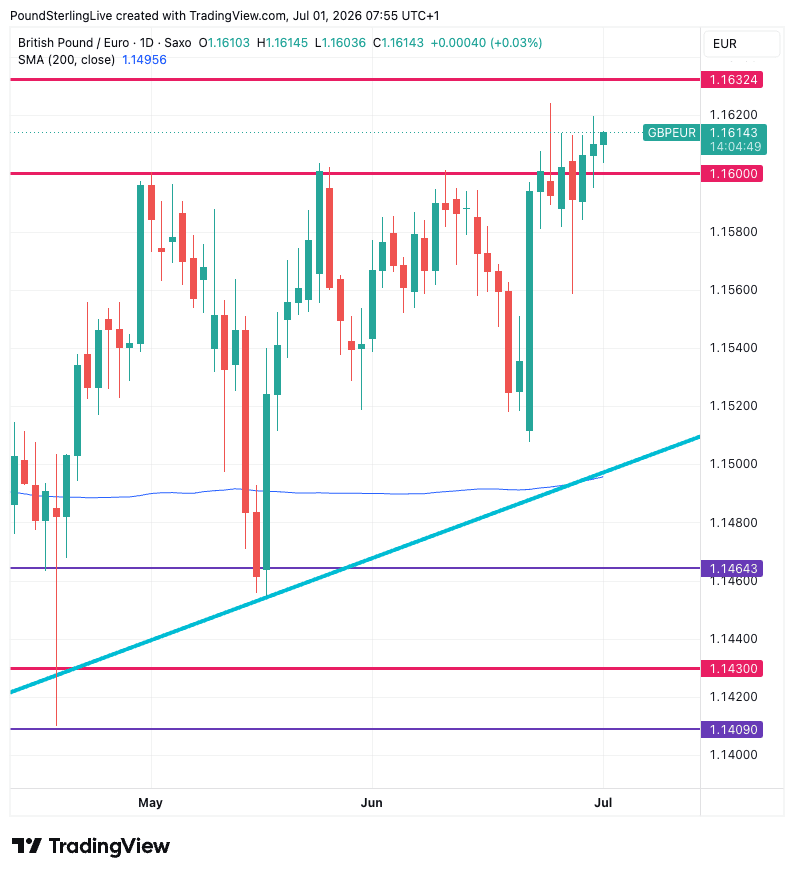
Above: GBP/EUR in steady grind through the 1.16 resistance barrier.
That risk premium started unwinding following November's budget, which wasn't as poorly received as the market had feared.
Nevertheless, Citi warns that renewed uncertainty surrounding UK politics could inject fresh volatility into gilt markets, eroding one of the pound’s key advantages.
The bank's rates strategists expect questions over the political outlook to keep government bond markets unsettled in the near term.
Beyond the next few months, Citi remains cautious on sterling, although less so than previously.
"We soften the magnitude of GBP underperformance," the bank says, noting that the pound still screens attractively on a carry-adjusted basis and that the Bank of England is unlikely to pivot dovishly over the next few meetings (i.e the residual support from gilt yields will remain).
Those factors should limit, rather than eliminate, sterling weakness.
Bank of England the Ultimate Arbiter
The longer-term concern is what happens once the Bank of England eventually begins lowering interest rates and whether fiscal risks return.
"Our forecasts still reflect medium-term headwinds in an eventual pivot towards cuts into Q2 2027 and the risk of higher borrowing."
Should investors begin demanding a higher premium to hold UK government debt, Citi says foreign demand for gilts could diminish, removing an important pillar of support for sterling.
There is, however, a bullish risk to the outlook.
"The bullish risk for GBP comes from second-round effects in services inflation, which could further delay the dovish pivot narrative and keep hikes pricing sticky," says Citi.
Here, pound sterling's gilt yield advantage becomes more potent.
What's the Forecast for the Pound versus the Euro?
Citi's forecast for the pound versus the euro is for a steady slide lower from current levels.
The institution's EUR/GBP forecasts see 0.87 on 0-3 month horizon and 0.87 on a 6-12 month view.
That translates into a steady, albeit lower, GBP/EUR of 1.15.
And What is the Forecast for the Euro?
Citi says the euro risks coming under greater pressure against the dollar, pencilling in a 1.13 level for the 0-3 month view.
However, analysts warn that the EUR/USD pair could even fall as low as 1.10 under a more severe episode of USD strength. If the GBP/USD lags that move, GBP/EUR would mechanically stay higher. But if GBP/USD underperformed EUR/USD during a bout of USD strength, GBP/EUR would find itself below the 1.15 forecast.
"EURUSD risks a move towards the 1.10 area should US inflation remain sticky enough to see markets price in further Fed hikes (even if they are not delivered). Even without such a development, momentum alone could see EURUSD fall further, at least temporarily," say Citi.