

Image © Adobe Images
For GBP/NZD, a break above 2.3000 would signal a more meaningful bullish shift.
The New Zealand dollar recovers some of last week's losses in Monday trade, helped by an improvement in global sentiment, which pressures GBP/NZD lower and signals some consolidation is at hand.
To be sure, the technical bias has turned modestly in favour of further gains following the 0.60% jump in the pound-to-New Zealand dollar that followed a hot U.S. jobs report, which all but confirmed the economy continues to perform strongly.
The market saw the print as another confirmation point that the Federal Reserve will be required to raise interest rates before year's end, prompting a repricing in bond markets that hit stocks and prompted a retrenchment in sentiment. This naturally weighed on the high-beta Kiwi dollar.
Monday sees some paring of that adjustment, and that has allowed the NZD to claw back lost ground against the pound and other currencies, opening the door to the prospect of near-term consolidation, albeit with a slight upside bias:
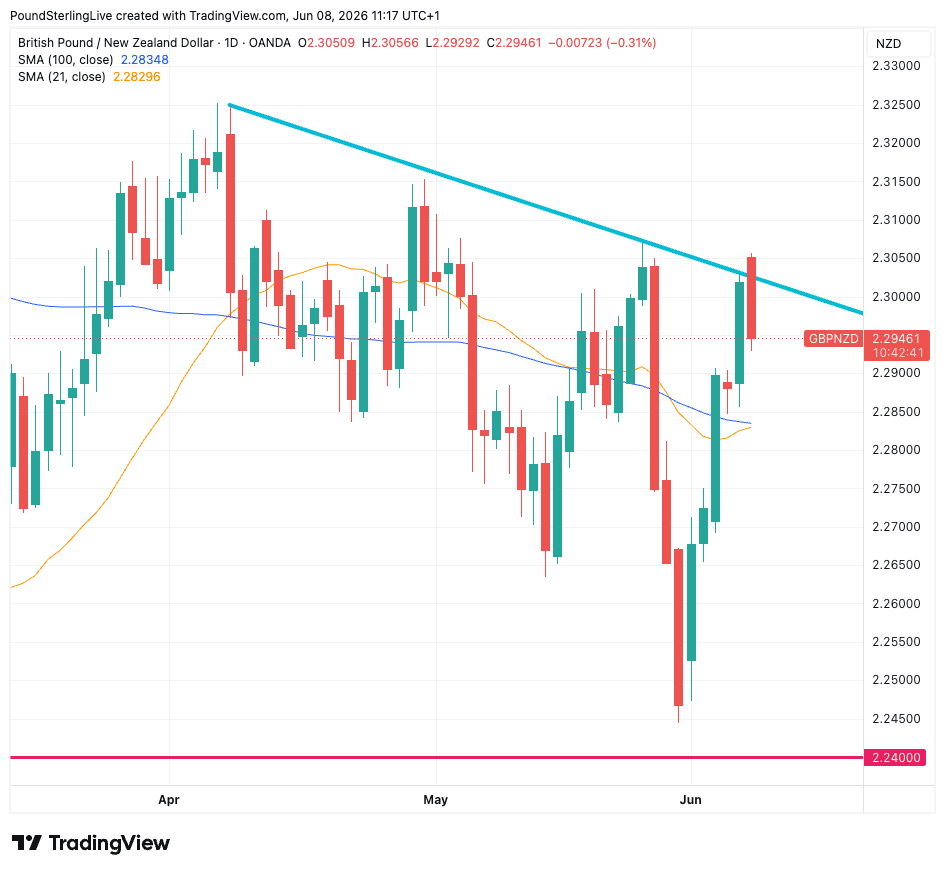
GBP/NZD enters the new week with an improved technical story after it successfully rebounded from the major 2.2400 support zone and reclaimed both its 21-day and 100-day moving averages.
The sharp reversal from the June low has shifted momentum back in favour of the pound and brought the pair back toward the descending trendline that has capped rallies since April.
Importantly, the GBP/NZD price is now trading above the moving-average cluster around 2.2830-2.2860, suggesting recent weakness was corrective rather than the start of a deeper downtrend.
The focus now shifts to down-sloping trendline resistance near 2.30: Sterling has already tested this area and briefly pushed above it before encountering selling pressure, confirming it remains the key battleground for the near-term outlook.
A decisive break above the trendline would represent a significant technical improvement, signalling that the two-month corrective phase is ending and opening the way toward the April highs above 2.32.
What's Happening in NZ This Week
It's a fairly light week for New Zealand with only second-tier data due for release. However, it should remain of interest to those trying to calibrate whether the RBNZ will raise interest rates in the coming months. (All times below are NZ local (Auckland); subtract 11 hours for BST.)
Tuesday 9 June, 10:45am: Wholesale Trade (Q1, prior +3.8%) and the Survey of Manufacturing sales volumes (Q1, prior +4.71%). The manufacturing volumes feed into the Q1 GDP build, so worth noting ahead of the GDP print later in the month.
Wednesday 10 June, 10:00am: ANZ Truckometer (prior 1,564), a timely activity proxy.
Friday 12 June, 10:30am: BusinessNZ Manufacturing PMI (prior 48.4, still in contraction). 10:45am: net long-term migration (prior +2,782) and visitor arrivals (prior 358,911).
As of last month, the RBNZ had signalled that hikes may be coming sooner than previously expected, with a first 25bp increase seen as possible before September, partly on oil-driven inflation concerns, so this week's data will be read through that lens.
For NZD, the rule of thumb is that any lift in interest rate expectations stemming from the data should be supportive.
U.S. Inflation in the NZD's Driving Seat
NZD fell in response to Friday's strong U.S. jobs report that prompted traders to fully price a rate hike from the Fed by year's end, reminding us that it's the U.S. economy that's wagging the FX tail.
Rising U.S. interest rate expectations are a natural throttle to global activity and investor sentiment, which is the channel through which it works on the NZ dollar.
With this in mind, the highlight of the week for FX is the release of U.S. inflation data on Wednesday, where a hot print would boost bets the Federal Reserve will need to raise rates, which would negatively impact markets and AUD.
Headline CPI is seen printing at 0.5% m/m, up from 0.6% in April, helping nudge the headline to 4.2% y/y from 3.8% in April.
Core CPI is seen at 0.3% m/m vs. 0.4% in April or 2.9% y/y vs. 2.8% in April.
These are the numbers the market will be watching: below here, AUD and stocks recover. Anything above, and sellers gain control again