

Photo by: U.S. Department of State (IIP Bureau).
There are four pillars of dollar weakness.
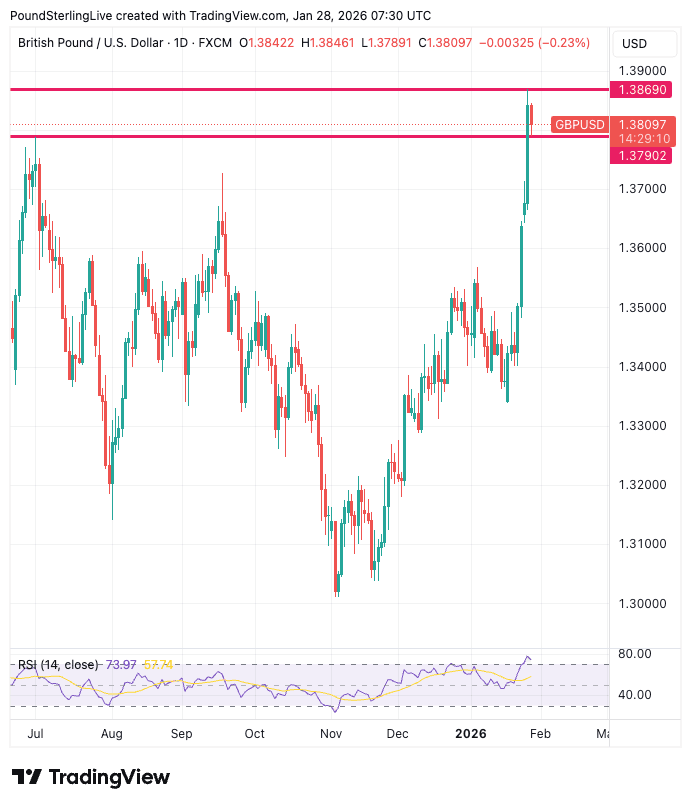
The pound to dollar exchange rate has cracked into the 1.38's in midweek trade following a remarkable 1.20% daily gain on Tuesday.
The advance builds on Friday's impressive 1.00% gain, and it's all down to a significant selloff in the dollar.
Dollars are being sold across the board and the British pound is coming along for the ride, hitting a new four-year high at 1.3868 on Tuesday.
At the time of writing midweek the advance has been pared somewhat with the pair retreating to 1.3808, leaving us asking whether this is a new top. (2025's rally stalled nearby at 1.3788, from where a noticeable pullback evolved).
GBP/USD is overbought on a technical basis, with the daily RSI reading above 70, but we won't be placing too much emphasis on this owing to the fundamentals underpinning the move: i.e. there's a big shift in global FX that is underway.
We noted yesterday that U.S. economic data and Federal Reserve interest rate expectations aren't the primary driver of the move: if they were we would be seeing outsized moves in U.S. bond markets. But bonds are proving relatively stable.
The dollar selloff began in earnest when it was revealed last Friday that Japanese and U.S. authorities were apparently coordinating to bolster the yen and weaken the dollar in a trans-Pacific currency pact.
This tells us the U.S. administration is now intent on actively pursuing a weak dollar policy in order to bolster the country's trading position, as a weaker currency will help U.S. exporters.
"The US being prepared to sell its currency to ‘help’ Japan stabilise the yen suggests that the US administration, for now, has no intention to block this part of the US debasement trade," says a note from KBC Bank.
Analysts at RBC Capital Markets identify three further pillars of the dollar selloff:
1: "A rotation trade from FX to precious."
This describes how precious metals such as gold and silver are bought by investors diversifying their exposure amidst fears of fiat currency debasement.
"Historically, all these metals have been currencies, gold for instance as recent as 1970. Risk aversion, diversification, inflation worries, and confidence all underpin this rotation to some extent, and appear to be long-run drivers," says Richard Cochinos, FX Strategist at RBC Capital markets.
2: "A rotation in FX reserve portfolios"
Similar to point 1, central banks have significantly increased their reserve holdings of gold. But RBC notes that other 'smaller' currencies have also benefited.
The IMF says reserves have grown by approximately $300BN in the past year, or 2.3%. The U.S. dollar now accounts for 56% of reserve manager portfolios compared to 71% before.
3: "U.S. curve steepening and Term premium"
RBC says there is a higher risk now associated with U.S. bonds, or Treasuries.
And, higher risk means greater hedging demand by investors.
This invariably means the selling of dollars today by international investors to cover losses associated with a weaker dollar and U.S. bonds in the future.
U.S. investors are also playing their part.
"Long-cycle risks remain, and inevitably as costs come down and country risks rise, currency hedging of existing assets can have a greater impact on the market price," says Cochinos.
There's also the issue of the dollar losing its 'carry' status. Carry is where investors seek higher interest rates, and the U.S. had offered the greatest interest rate returns until just this year.
However, the prospect of rate cuts in 2026 at the Federal Reserve diminishes that advantage. RBC says the U.S. now ranks fourth for 'carry', which inevitably acts as a headwind.