

Image © Adobe Stock
Our Week Ahead Forecast shows a break below 1.3218 is a very real prospect.
Pound sterling risks a break to fresh multi-month lows against the dollar in the coming days owing to a hefty dose of uncertainty relating to the war in the Middle East.
Investors are grappling with contradictory newsflow on Monday:
On the one hand, Donald Trump is ready to escalate and is considering a military operation to extract almost 1,000lb of uranium from Iran, according to a report. An invasion of Iran's oil loading hub of Kharg Island is also highly possible.
On the other hand, Trump says Iran has yielded to a number of his demands and is letting noticeably more oil tankers through the Strait of Hormuz.
It's clear he wants negotiations to continue but he's also ready to use force if necessary. That two-way uncertainty is keeping the dollar in check: sure, it has been well supported during the crisis, as tradition dictates, but it's hardly running away.
In fact, pound-dollar has looked distinctly consolidative during March and the lows at 1.3250 - which seem to form a baseline - have been defended on all major tests:
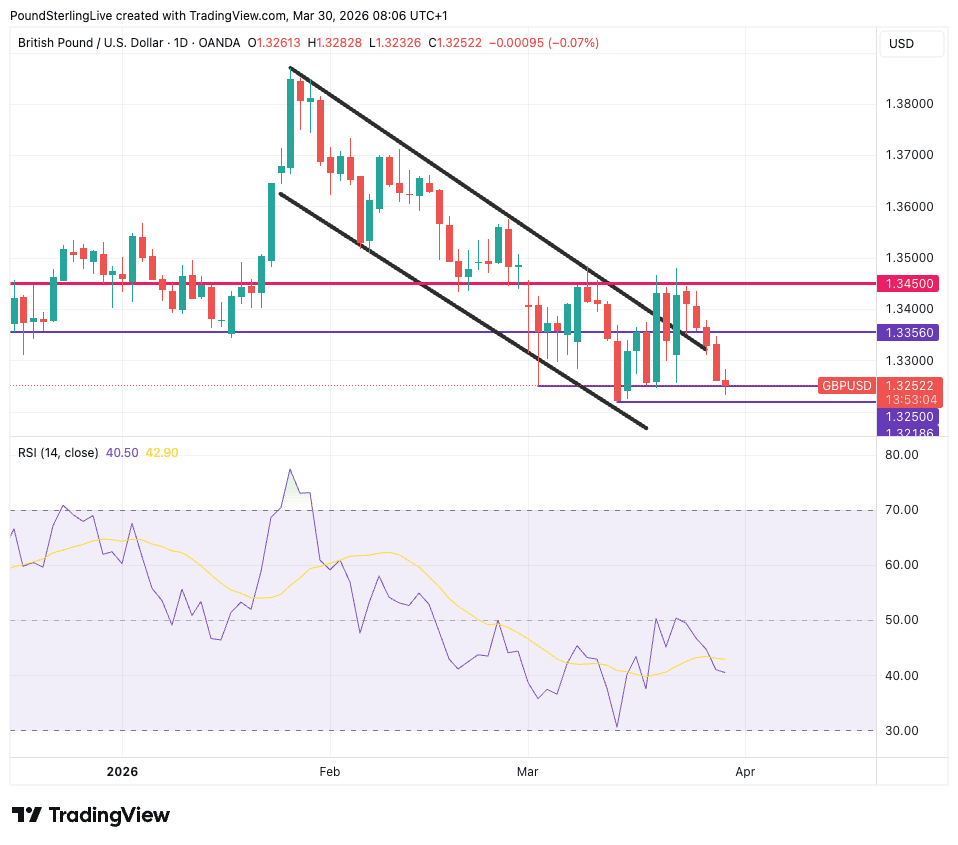
Above: GBP/USD at daily intervals with the RSI in the lower panel.
One indicator we're watching is the Relative Strength Index (RSI) on the daily charts, where a reading of 41 confirms there's no real trend momentum behind the pair as we approach the end of the month.
That being said, a run of four consecutive downdays does hint that immediate downside risks are building again.
If support at 1.3250 gives way, the next leg lower could follow relatively quickly, particularly in an environment where sentiment remains fragile.
For those with upcoming transfers, this kind of setup tends to shift the focus toward managing downside exposure rather than waiting for a clearer recovery signal.
The floor at 1.3250 will be a key line in the sand this week; already on Monday a low of 1.3233 has been printed. Will today's daily close happen below here? If it does, then we've got a strong hint that maybe follow-through selling awaits and April brings with it new four-month lows.
This would represent a material impact for those with looming GBP/USD payments, particularly when the wider margins typically charged by banks amplify the move.
Dollar Would Weaken "More Broadly"
Those with international payments in the coming week should consider what the dollar's failure to dominate during this crisis means for the outlook.
"The lack of trend strength for the dollar at precisely the time it should shine remains top of mind," says Themistoklis Fiotakis, FX analyst at Barclays.
"Overall, the dollar has undershot traditional gauges, including growth proxies, rate differentials, and to some degree even some of the higher dollar beta estimates. Meanwhile, dollar sentiment is now close to max bullish," he adds.
Barclays strategists say they are of the view that a few months out, whether via near-term escalation or immediate de-escalation, "tensions in the Middle-East are likely to decline. At that point the dollar could weaken more broadly."
That would open the door to a rapid recovery in the pound-dollar exchange rate.
In situations like this, having access to guidance can help manage both timing and execution, particularly where market signals remain mixed.