
Image © Adobe Images
Huge relief for global markets as Iran has opened the Strait of Hormuz to all commercial vessels, its foreign minister has announced.
Iran said the Strait of Hormuz now “completely open” to commercial traffic, a development that prompted a jump in global stocks and a fall in the dollar.
"Iran has agreed to never close the Strait of Hormuz again. It will no longer be used as a weapon against the World!" said U.S. President Donald Trump on Truth Social.
The pound-dollar exchange rate rallied to the cusp of 1.36 following the announcements, a level it has failed to clear this week and could yet stymie sterling's recovery.
GBP/USD surged through the first half of April as hopes for a reopening of the Strait grew, rising from 1.3160 to the cusp of 1.36 by the middle of this week, where it met resistance and fell back, having failed to advance through here on three occasions.
News that the Strait is finally reopening suggests a significant breakthrough in negotiations between the U.S. and Iran has been achieved.
We are however wary that the reopening theme is already largely 'in the price' of global financial assets, including GBP/USD, which means further gains are limited in the short-term.
According to one analyst we follow, it's entirely reasonable to expect the dollar selloff to eventually fade:
"Markets are tired," says Brent Donnelly at Spectra Markets. "A lot of capital and mental energy were spent in March. Markets can’t go pedal to the metal forever and now it’s time for some consolidation and chilling."
"USD weakness should continue but in a low volatility, grinding kind of way," he adds. "I do feel like we are in for a consolidation at this point, not because we are overbought but simply because people are burnt out and the market cannot sustain wild energy for long periods without new stimulation from news flow."
For GBP/USD, that should provide some guidance: further gains are possible here, but the pace will be slower and prone to periodic setbacks.
The Iran war remains the main trigger point for setbacks and advances: the market is optimistic that the war is in the endgame stage and that the Strait of Hormuz will be reopened in the coming weeks.
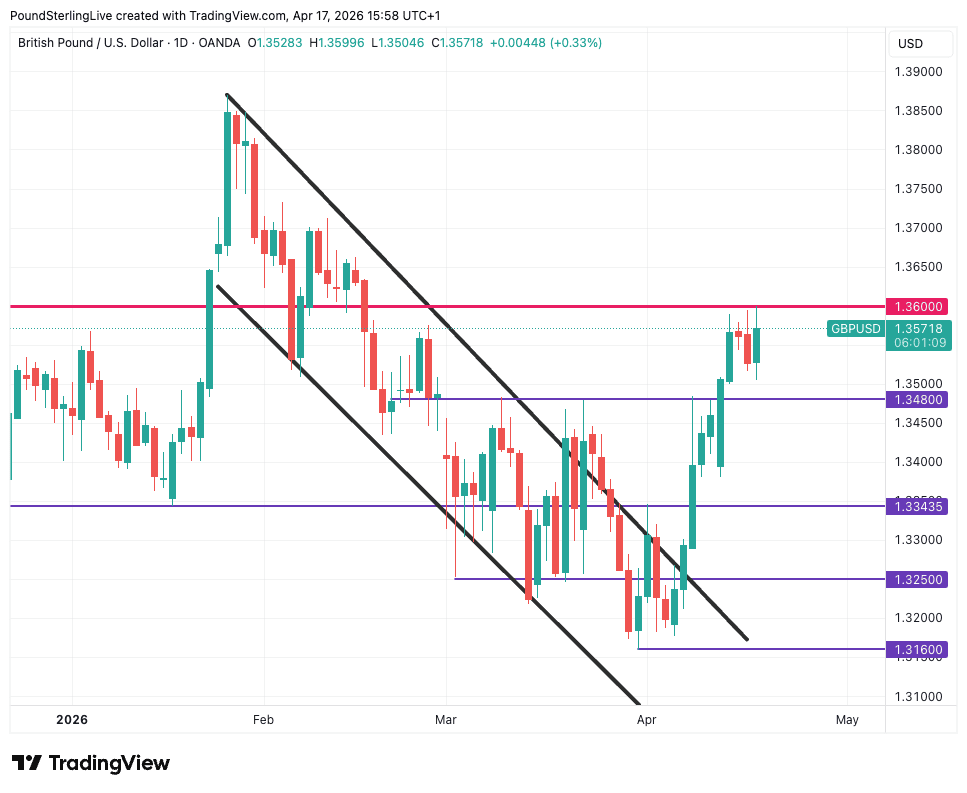
Above: 1.36 is a formidable resistance point for GBP/USD, stretching back into 2025.
For GBP/USD to fall materially, we would require a breakdown in negotiations between the U.S. and Iran and a re-escalation in hostilities.
"It’s difficult to think what would truly shock markets right here. Escalation in Iran will be scary for a short time (one day?) but with the AI fever back, people will simply say: Does Iran impact tech earnings? No? Okay cool," says Donnelly.
In short, the bar to further gains is low and a steady grind higher is on the cards for GBP/USD.
"I have been leaning bearish USD since turn of the month, but I think this is a good zone to take some profits. I don’t expect a reversal, just a loss of momentum and a consolidation," says Donnelly.